(practice-based research)
Liminal Systems treats practice as evidence. A prototype does not exist solely as an artwork; it is a test environment. The question is not only whether an experience is beautiful or compelling, but how it functions on attention, affect, embodiment, meaning, and memory.
(research cycle)
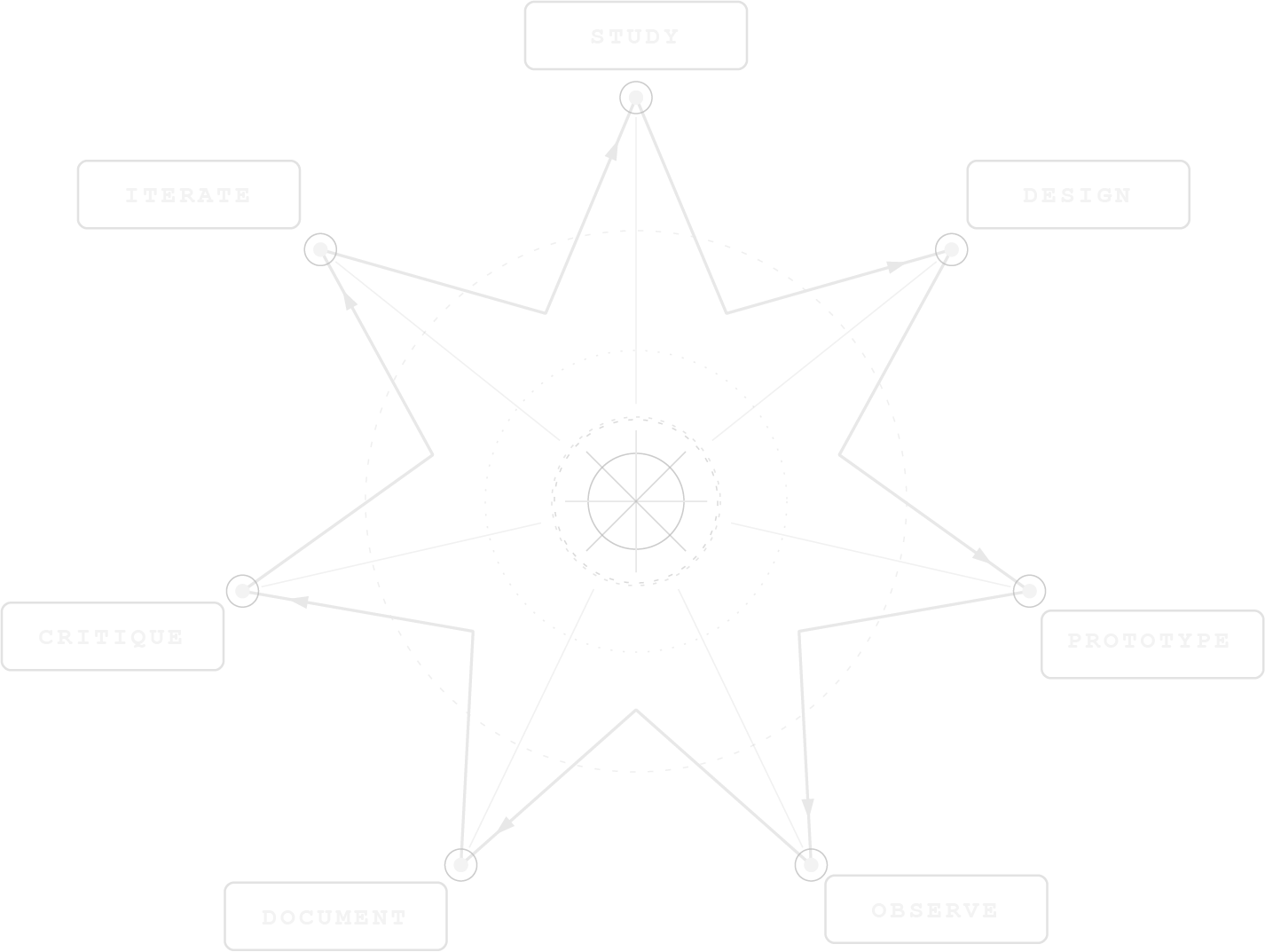
This system functions as a recursive, self-feeding loop rather than a linear sequence. Any point may serve as an entry point, because each activity can generate the conditions, questions, or material needed for the others.
Study informs design; design produces prototypes; prototypes create opportunities for observation; observation becomes documentation; documentation supports critique; critique drives iteration; and iteration generates new questions for study.
The process does not move toward a fixed endpoint. Instead, each pass through the system feeds new information back into the whole, allowing movement between stages as needed. A critique may return directly to design, an observation may require renewed study, or documentation may reveal the need for another prototype. The loop is therefore continuous, adaptive, and recursive: each cycle changes the conditions of the next.